Friday, February 25, 2022

Recording Acoustic Guitars

I want to start a new section on recording tricks I try that might be of some help when recording on a budget. This first one will be a quick trick to record acoustic guitars. Everyone knows that the trick to getting great sounding, wide acoustic guitars is to double track the guitars. Well here is a quick and simple method to getting it all done in one take. 

The setup on this isn't complicated. You only need one mic, an interface that has two inputs, and YOUR PHONE! 

I recorded this in Reaper the first track is done with a Lauten Audio LA220 a few inches away from the 12th fret.

The next the was recorded at the same time with a guitar cable going from the acoustic straight into the interface. The DI by itself sounds brittle so I added an Acoustic Guitar Impulse Response that I found online. 

ADHDguitarist · AC GTR DI 

The third was an idea to get a bit of the room for some space. I was really surprised at how good my two year old iPhone SE sounds. It's literally sitting on the desk next to my computer. 


Lastly I bus all of these tracks together, pan the mic and DI Left and Right, add in a bit of iPhone recording, then a touch of EQ Compression and some plate reverb. Keep in mind this is one take. 


You'll hear the separation more if your listening on headphones. The acoustic almost sounds like multiple guitars with plenty of seperation in the track for vocals. Next time I might try moving the phone to the other side of the room just to see what happens. 


Saturday, February 12, 2022

Looking for Singer Songwriters

Over the last few years I've gotten into recording and music production. While I'll be the first one to admit I've still got things to learn, I've think I've come a long way. One of my favorite things to do is collaborate with other artist, specifically artist that are a bit outside of my Hard Rock leanings. Recently I took a song from an artist that was just his vocal and an acoustic guitar. It's pretty obvious it was written as a soft quiet ballad. 


Originally I thought I would try to lean into the ballad, a few layers of acoustic guitar, a nice in the pocket guitar solo, maybe some vst strings.... But then I added drums and I double timed it. Suddenly the song took on a whole new life and I wanted to make an upbeat rock song. After a couple of days of playing around with the guitars I had an entirely different song. I added bass and tweaked the drums, then I took his vocals and layered them to create some harmonies and vocal effects. 


This is some of my favorite stuff to do and I'd like to do more of it. So if you or someone you know is a singer songwriter that wants to take their songs and turn them into something more reach out to me here, or on social media. 

Friday, January 14, 2022

Eventide MicroPtich Review

The Eventide Micropitch Delay has been out for a few months and I grabbed it as soon as it came out. I've seen a lot of videos and reviews on the in's and out's of this pedal but I've had a lot of questions about it too. What is it exactly? What can it do? What does it do that other pedals don't? How does it sound? And why would you want it? 

What is it exactly? 

For those that don't know the Micropitch it is ONE algorithm from the H9 pedal in a stand alone pedal. That might make it sound like it only does one sound, which is far from the truth. The "sound" comes from the early H910 and H949 studio units that led to the powerhouse H300 that was popular in professional studios in the 80's and 90's. Then guitar legends like Steve Vai and Eddie Van Halen started using them in their racks to get bigger guitar sounds. This is why I bought it. That 90's EVH W/D/W sound.  

What can it do?

At its core the Micropitch Delay has two independent delays that can be run in mono, stereo, or w/d/w. Along with the normal blend, tone and feedback controls each of these delays can be manipulated in various ways including pitch (up or down  a half step) and modulated. It even has filters for how the modulation is effected. On top of that you can MIDI control any of the functions! You want a wetter signal on the fly, sure. How about longer delay times, easy. You want a wider stereo spread? This is what it's all about!

What does it do that other pedals don't?

A lot. First off if your a fan of that 90's EVH sound and you own a 5150 amp (preferably at least two) then you want this pedal. Secondly most delay pedals don't have dual delays that are completely independent of each other and most of the ones that do are more expensive. Thirdly Eventide stuff has a certain "HiFi sheen" that I've never heard in anything else, and it adds a unique sound quality to your overall tone. Fourth, and this was a big seller for me, it has 5 presets you can access from the front of the pedal. More if you do MIDI which I don't. 

How does it sound?

In one word, Amazing. Seriously, other things get close but nothing is quite like the real thing. I run this in stereo going through the loop of my 5150 and into the return of a second amp. The first setting is perfect for that 90's EVH tone and while I've gotten pretty close with software this really does nail it. Of course ideally if you can go W/D/W it's even better. I've done this in a DAW and it's pretty insane. I also use a dual delay al'a Andy Timmons or David Gilmour (approximately 300ms and 450ms) and I use the envelope filter to add tape sag to the delays which sounds pretty wild even if it's subtle. And even after all these months I still feel like I'm scratching the surface of what it can do. 

Why would you want one?

1) You want the 90's EVH tone. Eddie was using this "still chorus" sound a bit more subtly all the way back to Diver Down, it just became more prominent on OU812. Some people love it, some don't. I'm someone who enjoys it. 

2) If (like me) you don't need all the functionality of the H9 but still want an incredibly flexible dual delay, with a handful of presets. 

3) This pedal can get some pretty wild tones out of it (barber pole delays anyone?) and those sounds can be inspiring. 

If your looking for a do everything delay you can get an H9 (it does a lot of other things) or a Timeline or for the price of a Micropitch a Source Audio Nemesis. But if you want "that" sound, that Eventide sound, that 90's EVH sound...  this pedal is well worth the price of admission. 

I did not receive compensation in any way for this review and my thoughts and comments are completely my own. 

Monday, January 10, 2022

Revv G3 Pedal Review

A few months ago, I was working at my day job in a customers home and I noticed quickly he had some very nice gear. We're talking several Friedman amps, Diezel, a Revv generator, and a ton of guitars. We got to talking shop (guitar, of course) and at the end of my work there he handed me this pedal. I was completely blown away! This is probably one of the nicest things a stranger has ever given me. When he handed it to me he said, this will be your new favorite drive channel. I had heard about Revv amplifiers and pedals but I'd never run across one and I have to say everything I had heard is absolutely correct. 

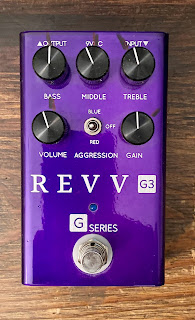
Controls are pretty typical of an amp in a box pedal, Volume, Gain, a three band eq and an "aggression" switch. I'm pretty sure the 3 band eq is active so start with everything at 12 o'clock and cut or boost depending on what your looking for. The Gain is useable through the entire range, it never gets muddy or mushy even on the highest settings. It is very dynamic and touch sensitive so it responds well to your pick attack and cleans up when you roll down the volume. That being said it never really gets "clean", then again that's probably not what your using it for anyway. 

 If you leave the aggression switch off it has a high gain crunch that sounds amazing pushed with higher output humbuckers (it sounds pretty good with PAF style and strat pickups too). In the up position your in "blue" mode. It adds a layer of compression and gain that sounds great for everything from 80's rock and up. The down position is the "red" mode and adds another layer of gain that nails a perfect modern high gain tone. Terms like articulate, clear, and brutal come to mind. It has a very tight bottom end that never gets flubby. My understanding is that the red G4 pedal has a bigger bottom end. 

Revv has been partnering with Two Notes Audio and is building their products right in to some of their latest amps. I use the Two Notes Wall of Sound Plugin with this plugin to add some power amp girth along with the speaker cabs. You can run this pedal in front of a clean amp or into the return of an effects loop. 

I will say that just like some amps take to pedals well and some need to be set a certain way, this pedal is the same. I can get a great crunch sound out of it but then hitting it with a TS or klon type pedal doesn't really work unless I have it set just so. Dynamically it reacts well but I don't love it when it comes to stacking with other pedals. That being said there is a ton of gain on tap and the active eq and the aggression switch make it pretty damn versatile. 

I did not receive compensation in any way for this review and my thoughts and comments are completely my own. 

Thursday, December 30, 2021

Confirmed: New Andy Timmons pedal coming

Chances are if you've found this blog you found it through one of my Andy Timmons post. I'm guessing this because my Andy Timmons Gear Guide is one of the most visited articles on this blog, by far. 

Andy Timmons recently put a picture up on Instagram that had a new pedal on top of his amps. This pedal reminded me of the Keeley ECCOS pedal so I started doing some digging. Sure enough both Robert Keeley and now Andy Timmons have confirmed that they have been working on a signature Andy Timmons Delay pedal. 


What we know so far

So far Keeley has put out the ECCOS and Hydra pedals on what he calls the "dream platform". The ECCOS is a stereo dual delay and the Hydra is a stereo reverb and tremolo. Both have programable settings, are easy to use but also allow for some very deep editing despite having only a few knobs and being in a standard pedal size. 

Keeley Electronics has trademarked the Name HALO DELAY as of a filling in June 2021 

In the past Andy used two EHX Deluxe Memory Man pedals, and then switched to using a Strymon Timeline to replicate this sound and to be more reliable. In the picture it says Halo on the pedal and Andy will be releasing a new album on April 1st 2022 featuring the pedal. Also on a livestream Andy said that the pedal should be released in March. 

Update 3/25/22 : looks like the rollout of the HALO DELAY pedal may be pushed back. I don't have any information other than Robert Keeley said that there was something "mind blowing coming after May and something supernova after that". 

Update 5/24/22: Someone on FB was looking for a Delay/Reverb pedal and Robert Keeley popped in and said that they might want to wait till June 10th! so I am assuming that it is indeed a Delay and Reverb and will be announced at Summer NAMM and available just after. 

What we don't know

Is it a Dual Delay or a Delay and Reverb. I'm guessing it's the second only because Andy's livestreams have had a lot of reverb on them recently. Either way I'm buying a new pedal in March and I'll try and get a review up as soon as possible. 

Update 6/10/22: It's out and the YouTube videos sound incredible. And it is a Dual Delay, yes of course I ordered it as soon as possible. I'll post some pics and videos on Instagram and thoughts here soon after. 


I'll keep this post updated if I get any more information. 

Monday, November 1, 2021

NGD Ibanez RGD IR7M


 Happy Birthday to me.... 

I've kind of wanted a 7 string ever since Steve Vai played one on Passion and Warfare and Whitesnake's Slip of the Tongue. But in those days 7 string guitars were rare and pretty expensive. In the early 2000's when every manufacture seemed to explode with less expensive 7's, the band I was in liked down tuned six strings. I didn't need a 7 and I was fine with that. Plus a lot of those less expensive seven strings had issues, the necks would twist and honestly I was a bit spoiled by some of my nice guitars. 

About two weeks ago I was again thinking about getting a 7 string when a used Sterling by MusicMan JP7 showed up at my local Guitar Center. Music Man's have always been a bit odd to me, I like them but for some reason I've just never fallen in love with one. Still I was thinking about going and checking it out. Then this Ibanez showed up at the same store. But with an hour drive I decided if I didn't love either of these guitars I wasn't going to get one.  Still I had to drive down and check them out. 

SPECS

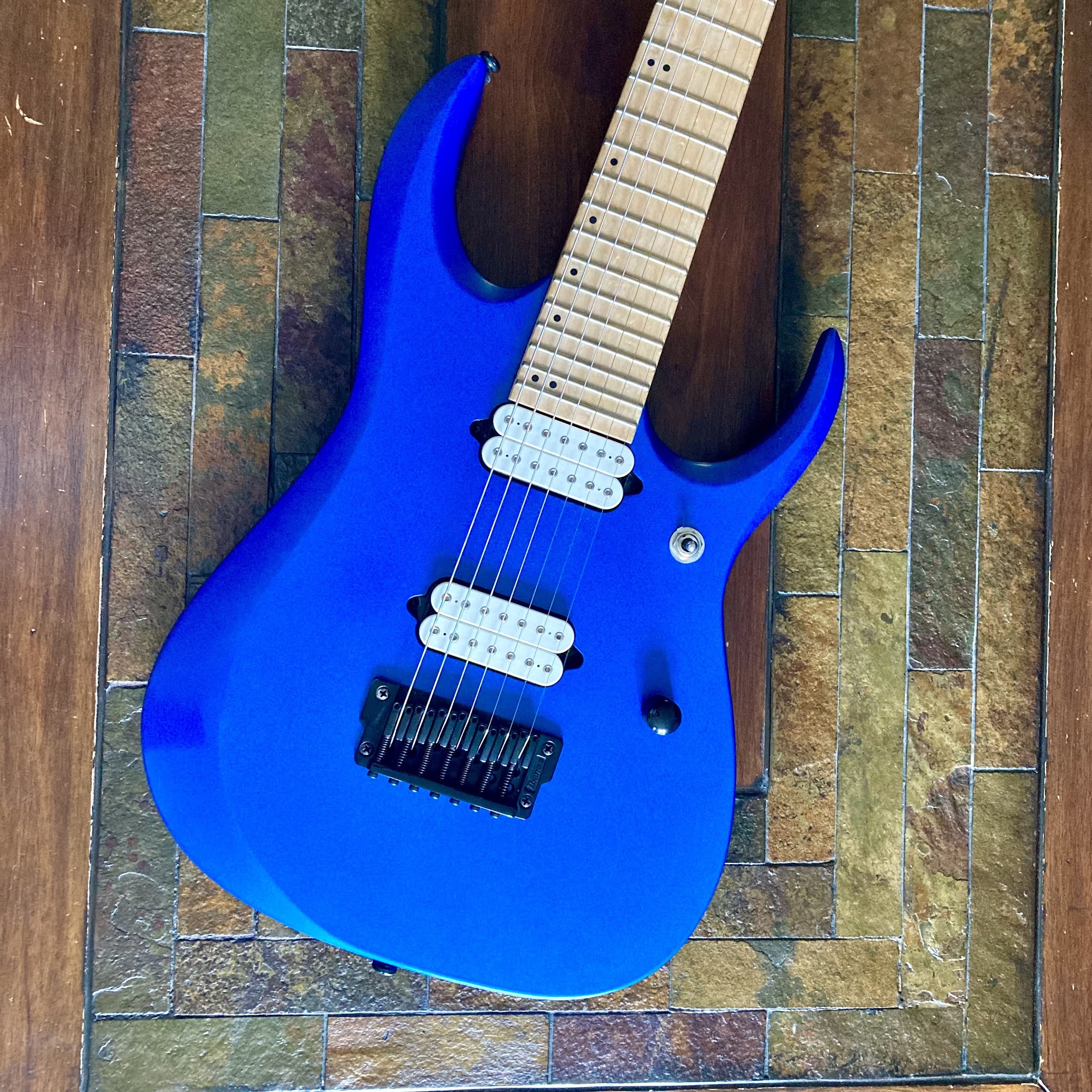
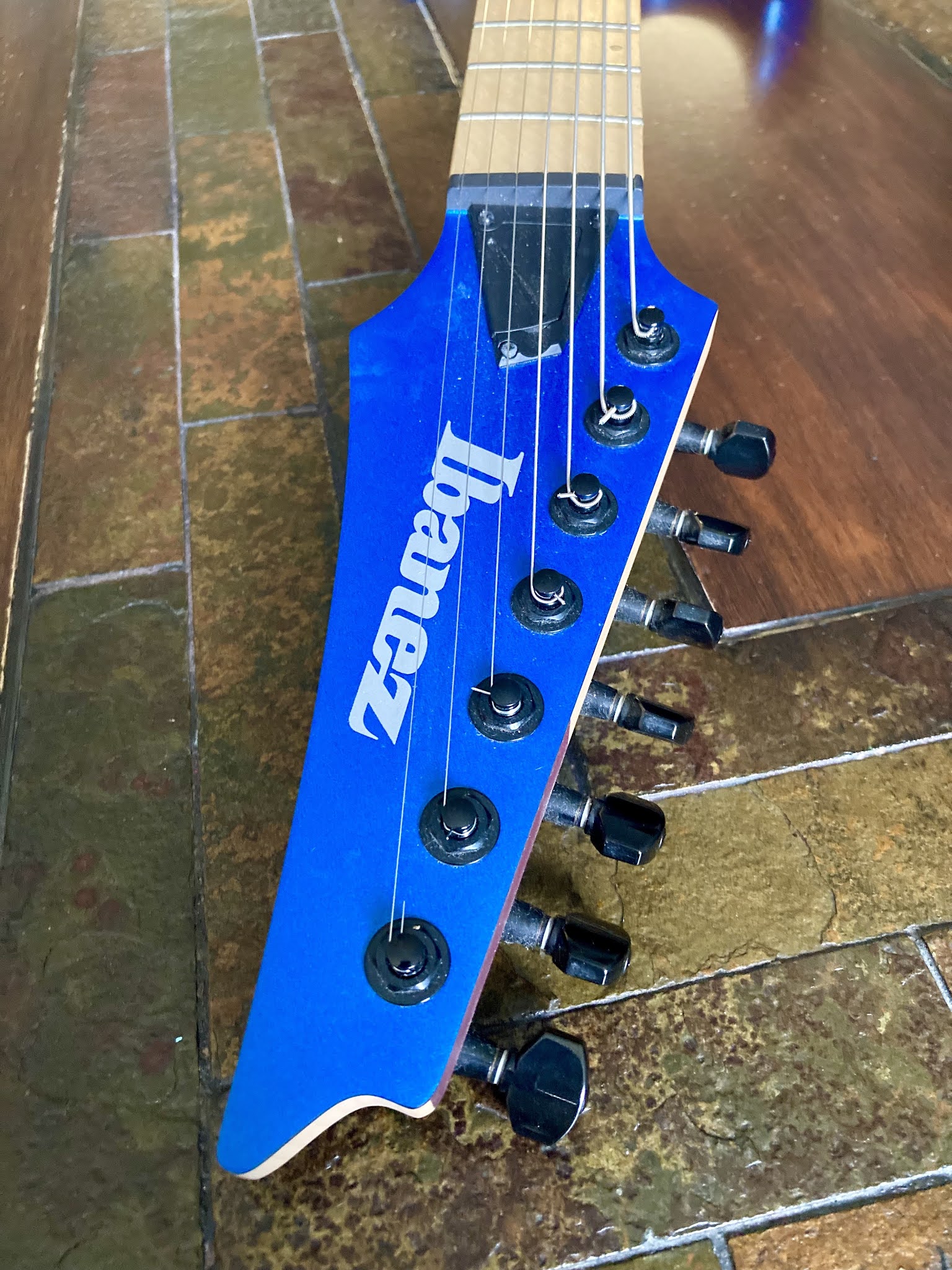
The RGD IR7M was made in 2018-2019. In 2018 they used mahogany and in 19 they used nyatoh a cousin to mahogany that sounds similar(this one is an 18) Other than that they are exactly the same. The locking tuners and the proprietary Gibraltar Bridge are made by Gotoh. The pickups are made by DiMarzio for Ibanez and are called Fusion Edge pickups. The finish is a matte metallic blue and the neck is a 3 piece and the fretboard is Birdseye maple. 

The Indonesian made Iron Label series has been out for a few years and if you read the online reviews they can be hit and miss. The factory they are made in is owned by Cort Guitars which is not a brand in the past I have associated with well made guitars, but the specs on this guitar intrigued me. 7 strings, hard tail, 26.5 inch scale. Also the blue is pretty sexy.

When I got to GC I checked out some of the other guitars first and then headed over to the used section. I played both guitars for a few minutes. The JP7 had a few dings and played fine but it didn't speak to me. But the Ibby on the other hand was in very good shape. There were no dings or scratches, just a bit of burnishing around the volume knob and on the upper bevel where the arm sits. There is also a tad bit of finish rubbed off the bass side of the bridge. The strings hadn't been changed in a long long time. If I had to guess someone bought it played it for a few weeks and put it in their closet. 

RESERVATIONS

I wasn't sure about the position of the switch but it sits just forward of where I tend to pick so it's never in the way and using it is as easy as sticking out a finger on my picking hand. I have to say I really like the extra inch on the scale length. Much like going from a 24.75 to 25.5 there is a difference in how the strings bloom. Also I had read a lot of mixed reviews on DiMarzio Fusion Edge pickups. I have to say I expected to dislike them but they sound pretty good and I've decided I will leave them for the time being. From what I've read online these are what the DiMarzio Titan's are based on. 

Now on to the most important thing. How does it play? Pretty great! This guitar plays as well as my Ibanez Prestige S1520BP which I have often said is like driving an exotic car. The neck is a bit thicker (and of course wider) but it's very comfortable. And the tension is very even all over the neck. A lot of lower end guitars have a very uneven tension. The Gotoh locking tuners keep the strings in tune very well. 

CONSIDERATIONS

So what might I change. I think I might swap out the volume pot for a push pull to take advantage of the coil splits and when I do that I'm going to have a graphtech nut put in. I've also read that Hipshot makes a direct replacement bridge for the Gibraltar II so that is an option. And the pickups? I don't know yet but at the moment I kind of like these. I do like the Seymour Duncan Alpha Omega set and I'm curious about Bare Knuckles so I'm considering them also. 


I don't know yet exactly where I'm going to fall with this guitar but I am really enjoying it. Aside from its djenty qualities it's a really nice playing guitar and it sounds really good. But considering the great shape it's in and that I got it at HALF of MAP pricing I'm gonna say it's a win! 

Wednesday, October 6, 2021

Getting Started into Recording

 I'm making progress with recording and mixing and all of that fun stuff. And I'm the first to admit I have a long way to go. But over the last couple of years I've learned a lot and I feel like there are some rabbit holes that are worth it and some that are not. So if your looking into learning this stuff I thought I'd start compiling a list of things. Some of these things are things I forget and need to remind myself. 


The order of importance

What's important? At the end of the day the song comes first, everything you do needs to be there to serve the song. To add to and not take away from, but this is subjective. And it's easy to think oh if I had a different DAW or Microphone (or pedal) or what did Stevie Ray Vaughn use? But none of that really matters. What matters first and foremost is the song. Is it good? Maybe. Now what about when it comes to recording... A great song recorded on a cassette tape through a cheap mic will be better than an ok song recorded at the legendary Ocean Way Studios and perfectly engineered by one of the masters. Ok? 

Second- The performance of the song is the second most important thing, and I think it's a close second. There is nothing like nailing a song on stage with the band and when recording it's the same. Yes you can time-align everything after the fact in most modern DAWs but when everyone nails their part it really does sound better for some reason. 

Third is the quality of the instrument.... ok we have a bit of a caveat here. Samples can go a long way to helping a lot of instruments and I've heard some incredible stuff done with samples. But it will help if the main instruments recorded. If your song is a just a vocal and a piano you should really try to find a real piano to record if at all possible. It will sound better. Are you playing an acoustic instrument? Tune it between every take. Is there a better quality acoustic guitar you can borrow for the recording do it, if not don't stress over it just make sure you nail the performance. 

Fourth is Mic choice and placement. If you look around on tutorials you'll find a lot of different mics mentioned but also a lot of people saying you just need a large condenser mic and that's it.  More and more I think that getting one large condenser mic and using that is fine for almost everything. But the reason for that is that it forces you to listen to the more important factor and that is PLACEMENT! How the mic and instrument and the room work together. One of the biggest pop stars on the planet right now is Billie Eilish and for her first two albums her brother recorded her with a $100 AT2020. Learning how to place the mic, and use it to get the best sounds is way more important than buying another mic. SOOOOO why does everyone spend all this money on more mics? Well they do sound different and some mics WILL lend themselves to different voices and instruments. But not nearly as much as placement. 

Fifth and way way way way down on the list is outboard gear. Preamps, compressors, EQs and all of that stuff is kind of fun, and expensive. Do you need it? nope. Can it be useful? yep. The fact is that most of that stuff can be modeled in your DAW by plugins. BUT I do believe it is better.... but only marginally. If you've got the budget then spend the money. If your trying to make things 2% better then do it. But if your mixes sound like mud (which mine did for a long time) no outboard gear is going to help. Sorry. 

Sixth and even farther way down the list is the analog to digital converters. The reason for this is that most AD converters these days are really great and you don't have to worry about them unless you going in and out of your DAW to run those sounds through rack gear. 

So if You don't need that what do you need?

Where should you spend your money? My vote for most people is lessons, there is a lot of people on YouTube showing you different ways to do things at different levels. But find a couple of people who explain things to you in a way that makes sense to you. Maybe that's Recording Revolution, or Joe Gilders Home Studio Corner, or Produce like a Pro, just to name a few. If you're on a budget sign up for their mailing list and then wait for a sale. 

The next thing is to start recording stuff. Do you remember when you started playing guitar (or whatever instrument you started on)? Could you play like Steve Vai right away? nope, I've been playing for years and I still can't. But if you're like most people you started learning easy songs, I think my first one was Rock you Like a Hurricane. Revisit those first few songs and record them, You'll learn a ton, including what you don't know and what you need to work on. 

I've messed around with recording for several years and it's only in the last couple of years that I find myself getting to where I am happy with the sound of my mixes. My vocals on the other hand, that's going to take a lot of work. haha