Showing posts with label Review. Show all posts

Friday, July 1, 2022

Keeley HALO Andy Timmons Dual Delay Review

It's been a long time coming, but the Keeley Electronics Halo aka Andy Timmons Dual Delay pedal is finally here and I couldn't resist ordering it as soon as it came out. And I can't stop playing it! Not surprisingly it's a gorgeous sounding delay that is both versatile and easy to use. 

Andy Timmons sound has more to do with his phrasing and attack than anything else and like most of us his tone has evolved over time. If you're trying to replicate the sounds in the Mesa Boogie video from 2009 you might be disappointed to learn that this isn't exactly that. This is a very versatile yet easy to use, small form factor delay pedal that has the delay sound that Andy has been dialing in for the last few years.

In an interview with Doug Doppler Andy talked about moving from the Echoplex to the Deluxe Memory Man to the Strymon Timeline. They all sound great but the Echoplex and DMM would break down easily  and while the Strymon is a fantastic do it all delay he only used a few sounds out of it and felt like if he could have those sounds in a small pedal then that would be the one. Then he heard the Keeley ECCOS, a small highly tweakable programable delay pedal that sounded as good as the Timeline. So after spending a few days with Robert and his team the idea of the Halo was born. 

This is not a Do It ALL delay. It doesn't do ping pong delays, and you can't have two different times on two different amps like in the old Mesa Boogie video. It's also not Midi capable. So if you need those things this may not be the delay pedal for you. So what can you do with it? 

First off I want to take about the quality of the sound. I tend to use 4 different delay sounds, and a lot of programable digital delays can end up sounding anemic to my ears. My favorite delay for a while now has been the Way Huge Echo Puss, but I can't program that to have all 4 sounds readily at my disposal. But the Halo can do both and more. The delay sounds are full and warm, you can add tape style saturation, bucket brigade grit and modulation to the repeats. Beautiful ambient soundscapes are as readily available as simple slapback sounds. 

The 5 knobs on the top of the pedal all double in function giving you access to 9 different parameters with the main functions being the ones you'll use the most. The alternate functions are things most people will program and leave alone like the high pass filter and saturation. There is also tap tempo and a "hold" available via the foot switches. There are stereo in and out jacks and jacks to plug in an expression pedal and remote switches and there are 4 banks each with two presets for a total of 8 programable presets. That's a lot of options for a pedal that is smaller than the Echo Puss! 

With all of these options you might wonder how easy it is to use. It's very simple. I sat down a couple of days after I got the Halo with my main sound on my EchoPuss to see how close I could get. It took me about 20 minutes of going back and forth. There is a slight difference in the way the two pedals saturate but otherwise they sounded identical. One of the cool features is that when you turn a knob a blue light lets you know that you've changed something. If you turn that knob back to its original spot the light turns off! Now you'll know exactly where you had that knob to begin with. Brilliant!!

Paired with the AT+ Drive the first setting is instant Timmons tone! Now I understand all the reverb type sounds I was hearing on Andy's livestreams. It's part of the first setting, the way that the delays sit just behind what you're playing and also build a bit of a pad around the notes reminds me of reverb. If you use an expression pedal this might be all you ever need. You can set up the expression pedal to connect to any of the parameters but if you just plug it in it will control the overall level of the repeats so when you roll it back the first setting adds just enough ambiance to your sound to add a little something but then when you add it back it's a perfect trail of notes for long meandering solos. Running in stereo it does add an interesting bouncing back and forth with this setting but it's not exactly ping pong. I absolutely love the hold button that lets you hold those sounds and let them build up. It's ideal for when you need to fill space in a song with something interesting. 

I find most delay pedals can either do nice ambient behind the note sounds or dotted 8th type delays. The ones that can do both well are larger and expensive. The Halo can easily do both of these and with a sound quality that rivals the best in the business. Gilmour-ish type soaring lead delays? Check. EVH Cathedral type delay? Check. U2 dotted eighth delays? Check! Old school slap back? Easy. Tape Saturation? Done!

As I stated before, there are things this pedal doesn't do (like midi) but if you don't need those functions this delay pedal is certainly worth checking out. I can't think of another delay pedal that has this quality of sound, and has this many features in this small of a package. 

I'm working on a track that will highlight some of the sounds of the Halo that should be available soon. Also yes I purchased this with my own money I did not receive compensation in any way for this review and my thoughts and comments are completely my own. 

Wednesday, May 11, 2022

Warm Audio WA-12 Review

I wasn't originally going to do a "review" of this product. While I've played through numerous versions of a Tube Screamer, I don't have a lot of experience with outboard gear. But I I got a great deal from Sweetwater (who is currently blowing out the orange version) and was surprised at how much easier this has made my workflow. Let me explain. 

My old interface was a cheap one, just something to experiment with, and you had to chose mic/line or instrument level before you plugged something in. If you plugged in a TRS cable and turned on the phantom power it would send phantom power over the TRS cable, which I guess can be useful, but could also fry a mic pre. My current interface is the IK Multimedia AXE I/O. It's a 2 in 5 out interface that has good quality clean mic pre's built in. With the AXE I/O when you turn on phantom power it sends it to both inputs, but there is a kill switch when you input a TRS which in turn removes the phantom power from just that one. (there is another one when you plug in an instrument, this is smart) It is well known that microphones will make a bigger impact on your sound than a preamp, and you can get those preamp sounds out of plugins. So why buy the Warm Audio WA-12 when I can get those sounds in a plugin?

Flexibility: The WA-12 has a TRS line level out as well as a mic out. So before if I was using two mics they either had to be two dynamic mics or two condenser (phantom powered) mics. Now I can have either or both. 

Headroom: Line level is higher which therefor offers more headroom. This allows more dynamic range out of my mics, I can run them quieter so that it doesn't pickup as much room noise or higher for more details. 

Louder perceived volume: The WA-12 is based on the old API312 preamp. As you crank the input volume of the mic it hits a transformer that adds 2nd order harmonics adding saturation to the recording. Once again you can do this with plugins but you can add very subtle saturation and actually lower the overall volume level of your recorded track while making it sound louder! Now if you want a lot of saturation click the pad button and crank the input and you're in saturated heaven. 

Tone Choices: There is a button on the front of the WA-12 marked tone. This changes the impedance of the preamp which, depending on the mic, can alter the tone. It's a great cure for cheaper overly bright mics. 

So now I can leave more stuff plugged in. I don't have to decide between only dynamics or condensers when recording with two mics. I have more available dynamic headroom out of the AXE I/O. I have more tone options. 

I'm starting to feel like this is a rabbit hole. Like I can see some sort of patch bay working it's way into my setup and then a bit more rack gear.... oh boy. haha. 

Friday, January 14, 2022

Eventide MicroPtich Review

The Eventide Micropitch Delay has been out for a few months and I grabbed it as soon as it came out. I've seen a lot of videos and reviews on the in's and out's of this pedal but I've had a lot of questions about it too. What is it exactly? What can it do? What does it do that other pedals don't? How does it sound? And why would you want it? 

What is it exactly? 

For those that don't know the Micropitch it is ONE algorithm from the H9 pedal in a stand alone pedal. That might make it sound like it only does one sound, which is far from the truth. The "sound" comes from the early H910 and H949 studio units that led to the powerhouse H300 that was popular in professional studios in the 80's and 90's. Then guitar legends like Steve Vai and Eddie Van Halen started using them in their racks to get bigger guitar sounds. This is why I bought it. That 90's EVH W/D/W sound.  

What can it do?

At its core the Micropitch Delay has two independent delays that can be run in mono, stereo, or w/d/w. Along with the normal blend, tone and feedback controls each of these delays can be manipulated in various ways including pitch (up or down  a half step) and modulated. It even has filters for how the modulation is effected. On top of that you can MIDI control any of the functions! You want a wetter signal on the fly, sure. How about longer delay times, easy. You want a wider stereo spread? This is what it's all about!

What does it do that other pedals don't?

A lot. First off if your a fan of that 90's EVH sound and you own a 5150 amp (preferably at least two) then you want this pedal. Secondly most delay pedals don't have dual delays that are completely independent of each other and most of the ones that do are more expensive. Thirdly Eventide stuff has a certain "HiFi sheen" that I've never heard in anything else, and it adds a unique sound quality to your overall tone. Fourth, and this was a big seller for me, it has 5 presets you can access from the front of the pedal. More if you do MIDI which I don't. 

How does it sound?

In one word, Amazing. Seriously, other things get close but nothing is quite like the real thing. I run this in stereo going through the loop of my 5150 and into the return of a second amp. The first setting is perfect for that 90's EVH tone and while I've gotten pretty close with software this really does nail it. Of course ideally if you can go W/D/W it's even better. I've done this in a DAW and it's pretty insane. I also use a dual delay al'a Andy Timmons or David Gilmour (approximately 300ms and 450ms) and I use the envelope filter to add tape sag to the delays which sounds pretty wild even if it's subtle. And even after all these months I still feel like I'm scratching the surface of what it can do. 

Why would you want one?

1) You want the 90's EVH tone. Eddie was using this "still chorus" sound a bit more subtly all the way back to Diver Down, it just became more prominent on OU812. Some people love it, some don't. I'm someone who enjoys it. 

2) If (like me) you don't need all the functionality of the H9 but still want an incredibly flexible dual delay, with a handful of presets. 

3) This pedal can get some pretty wild tones out of it (barber pole delays anyone?) and those sounds can be inspiring. 

If your looking for a do everything delay you can get an H9 (it does a lot of other things) or a Timeline or for the price of a Micropitch a Source Audio Nemesis. But if you want "that" sound, that Eventide sound, that 90's EVH sound...  this pedal is well worth the price of admission. 

I did not receive compensation in any way for this review and my thoughts and comments are completely my own. 

Monday, January 10, 2022

Revv G3 Pedal Review

A few months ago, I was working at my day job in a customers home and I noticed quickly he had some very nice gear. We're talking several Friedman amps, Diezel, a Revv generator, and a ton of guitars. We got to talking shop (guitar, of course) and at the end of my work there he handed me this pedal. I was completely blown away! This is probably one of the nicest things a stranger has ever given me. When he handed it to me he said, this will be your new favorite drive channel. I had heard about Revv amplifiers and pedals but I'd never run across one and I have to say everything I had heard is absolutely correct. 

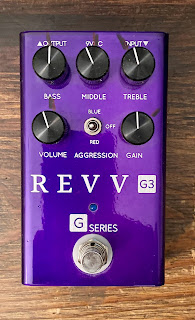
Controls are pretty typical of an amp in a box pedal, Volume, Gain, a three band eq and an "aggression" switch. I'm pretty sure the 3 band eq is active so start with everything at 12 o'clock and cut or boost depending on what your looking for. The Gain is useable through the entire range, it never gets muddy or mushy even on the highest settings. It is very dynamic and touch sensitive so it responds well to your pick attack and cleans up when you roll down the volume. That being said it never really gets "clean", then again that's probably not what your using it for anyway. 

 If you leave the aggression switch off it has a high gain crunch that sounds amazing pushed with higher output humbuckers (it sounds pretty good with PAF style and strat pickups too). In the up position your in "blue" mode. It adds a layer of compression and gain that sounds great for everything from 80's rock and up. The down position is the "red" mode and adds another layer of gain that nails a perfect modern high gain tone. Terms like articulate, clear, and brutal come to mind. It has a very tight bottom end that never gets flubby. My understanding is that the red G4 pedal has a bigger bottom end. 

Revv has been partnering with Two Notes Audio and is building their products right in to some of their latest amps. I use the Two Notes Wall of Sound Plugin with this plugin to add some power amp girth along with the speaker cabs. You can run this pedal in front of a clean amp or into the return of an effects loop. 

I will say that just like some amps take to pedals well and some need to be set a certain way, this pedal is the same. I can get a great crunch sound out of it but then hitting it with a TS or klon type pedal doesn't really work unless I have it set just so. Dynamically it reacts well but I don't love it when it comes to stacking with other pedals. That being said there is a ton of gain on tap and the active eq and the aggression switch make it pretty damn versatile. 

I did not receive compensation in any way for this review and my thoughts and comments are completely my own. 

Monday, November 1, 2021

NGD Ibanez RGD IR7M


 Happy Birthday to me.... 

I've kind of wanted a 7 string ever since Steve Vai played one on Passion and Warfare and Whitesnake's Slip of the Tongue. But in those days 7 string guitars were rare and pretty expensive. In the early 2000's when every manufacture seemed to explode with less expensive 7's, the band I was in liked down tuned six strings. I didn't need a 7 and I was fine with that. Plus a lot of those less expensive seven strings had issues, the necks would twist and honestly I was a bit spoiled by some of my nice guitars. 

About two weeks ago I was again thinking about getting a 7 string when a used Sterling by MusicMan JP7 showed up at my local Guitar Center. Music Man's have always been a bit odd to me, I like them but for some reason I've just never fallen in love with one. Still I was thinking about going and checking it out. Then this Ibanez showed up at the same store. But with an hour drive I decided if I didn't love either of these guitars I wasn't going to get one.  Still I had to drive down and check them out. 

SPECS

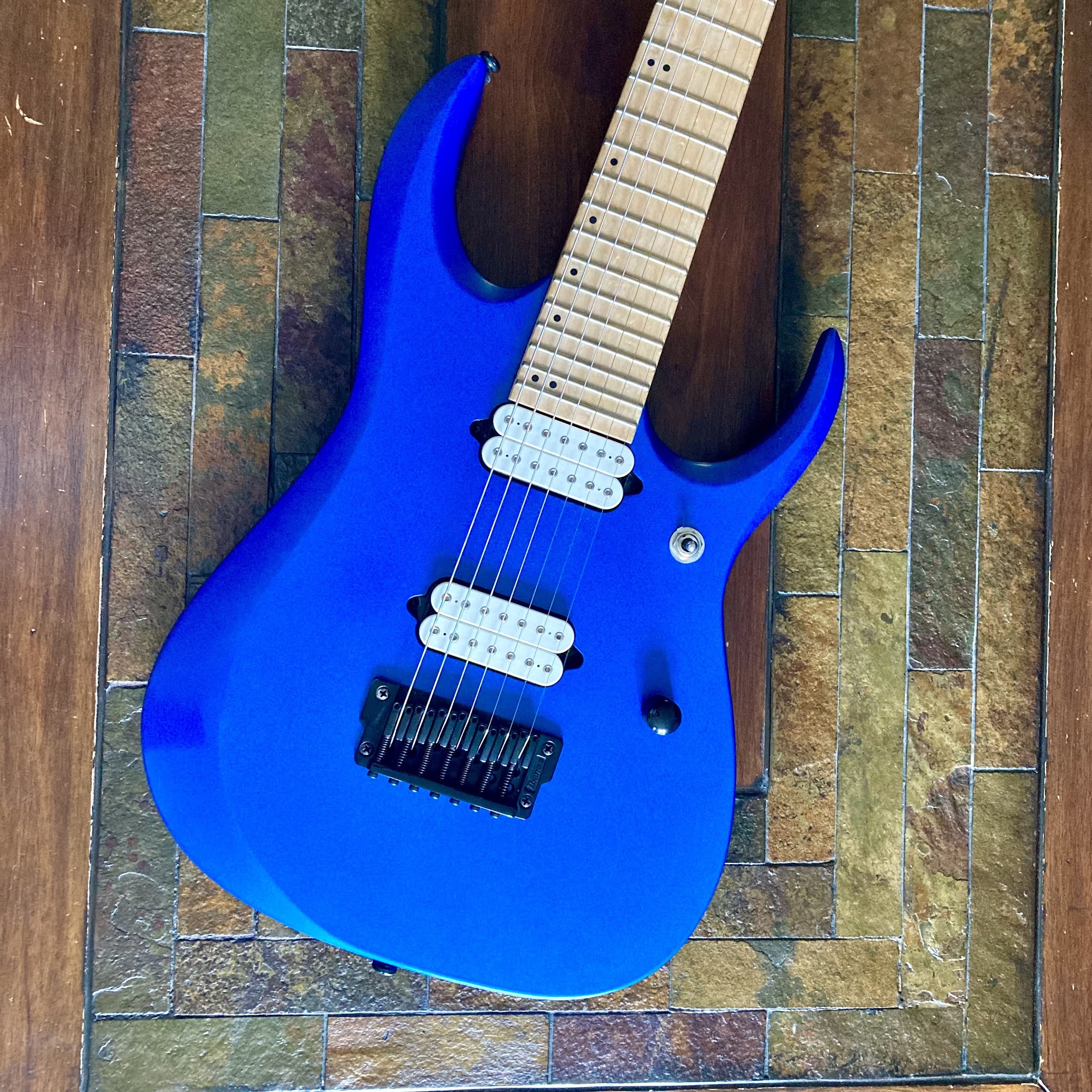
The RGD IR7M was made in 2018-2019. In 2018 they used mahogany and in 19 they used nyatoh a cousin to mahogany that sounds similar(this one is an 18) Other than that they are exactly the same. The locking tuners and the proprietary Gibraltar Bridge are made by Gotoh. The pickups are made by DiMarzio for Ibanez and are called Fusion Edge pickups. The finish is a matte metallic blue and the neck is a 3 piece and the fretboard is Birdseye maple. 

The Indonesian made Iron Label series has been out for a few years and if you read the online reviews they can be hit and miss. The factory they are made in is owned by Cort Guitars which is not a brand in the past I have associated with well made guitars, but the specs on this guitar intrigued me. 7 strings, hard tail, 26.5 inch scale. Also the blue is pretty sexy.

When I got to GC I checked out some of the other guitars first and then headed over to the used section. I played both guitars for a few minutes. The JP7 had a few dings and played fine but it didn't speak to me. But the Ibby on the other hand was in very good shape. There were no dings or scratches, just a bit of burnishing around the volume knob and on the upper bevel where the arm sits. There is also a tad bit of finish rubbed off the bass side of the bridge. The strings hadn't been changed in a long long time. If I had to guess someone bought it played it for a few weeks and put it in their closet. 

RESERVATIONS

I wasn't sure about the position of the switch but it sits just forward of where I tend to pick so it's never in the way and using it is as easy as sticking out a finger on my picking hand. I have to say I really like the extra inch on the scale length. Much like going from a 24.75 to 25.5 there is a difference in how the strings bloom. Also I had read a lot of mixed reviews on DiMarzio Fusion Edge pickups. I have to say I expected to dislike them but they sound pretty good and I've decided I will leave them for the time being. From what I've read online these are what the DiMarzio Titan's are based on. 

Now on to the most important thing. How does it play? Pretty great! This guitar plays as well as my Ibanez Prestige S1520BP which I have often said is like driving an exotic car. The neck is a bit thicker (and of course wider) but it's very comfortable. And the tension is very even all over the neck. A lot of lower end guitars have a very uneven tension. The Gotoh locking tuners keep the strings in tune very well. 

CONSIDERATIONS

So what might I change. I think I might swap out the volume pot for a push pull to take advantage of the coil splits and when I do that I'm going to have a graphtech nut put in. I've also read that Hipshot makes a direct replacement bridge for the Gibraltar II so that is an option. And the pickups? I don't know yet but at the moment I kind of like these. I do like the Seymour Duncan Alpha Omega set and I'm curious about Bare Knuckles so I'm considering them also. 


I don't know yet exactly where I'm going to fall with this guitar but I am really enjoying it. Aside from its djenty qualities it's a really nice playing guitar and it sounds really good. But considering the great shape it's in and that I got it at HALF of MAP pricing I'm gonna say it's a win! 

Monday, June 22, 2020

Digitech Freqout Review

There are several different types of artificial sustainers on the market including hand held ones like the ebow and pickups with built in oscillators but pedal sustainers have been mostly let downs for me. the Digitech Freqout has been out for a while and I had seen a few recommendations for it and I was pretty skeptical but I have been quite surprised. 

The Freqout has a very industrial look with a brushed aluminum finish and a screen print on the top that sets it apart from pretty much anything else. 


The first switch can set the foot switch to be a momentary switch meaning it only works when you're stepping on the switch and when you release it turns off. This is great for providing sustain and feedback on demand. Or you can leave it off to act like a normal pedal, keep in mind it is only true bypass if the momentary is left off. The dry switch can kill your initial attack so that all you hear is the effect. This can be used to replicate ebow type sounds. While the pedal looks to have two knobs it actually has 3. The top knob has a Gain and an Onset knob. Onset is how soon the effect kicks in while the Gain knob controls how strong the effect is. These are crucial to how natural the effect will feel. The Type knob sets the feedback that comes in from an octave down to an octave up and you can choose 3rds and 5ths as well as others. There is also a set of LED lights on the left side to help you see when the effect kicks in. 

There is an old trick with cranked tube amps where you stand at a certain spot on the stage and can step back towards your amp for more sustain and closer for more feedback. Most shows I've attended in the last few years have moved to quieter stages and modeling boards and software and you lose that ability. While the freqout isn't exactly that same feel it does help add that feel back in. 

As much as I enjoy a cranked tube amp I find myself using amp sims more and more for practice and recording. The Freqout really does help add a more "live" feel. I love being able to add feedback in a song when recording direct. It also does cool ebow sounds and also ambient drones very well. I've been using it to create pad type sounds with clean chords. 

Keep in mind this pedal reacts with your pickups and needs to be placed absolutely first on your pedalboard. Before wah pedals, compressors and even fuzz pedals so if you have a finicky fuzz pedal it may not work with your setup. This pedal is super fun and great for experimenting with. 

I did not receive compensation in any way for this review and my thoughts and comments are completely my own. 

Tuesday, August 6, 2019

JHS AT Drive Andy Timmons Pedal Review

There is a sound I have searched for, a sound that I first noticed in David Gilmour's Live in Gdansk, Eric Johnson had something similar, Andy Timmons had "that sound" too. Part of it is phrasing but as I dug and dug into their somewhat complicated rigs I found it was partly the sound of the BK Buttler Tube Driver. I say partly because the Tube Driver has to be played into a cranked amp to get that sound and sounds awful at low volumes. With all three of them it is an EL34 based amp. The Hiwatt's for Mr Gilmour and for Eric and Andy old Marshall Plexi's set somewhat clean or crunchy. Andy later switched to Mesa's particularly the Stiletto (which if you read my review was a tweaked clone of his two plexi's). Then a while back JHS and Andy released the AT drive and then shortly after that the AT Drive V2. Then I noticed the Tube Driver wasn't on his board anymore.

I've been using an OCD clone using Bjorn Riss's settings to duplicate the Tube Driver but I finally got my hands on the JHS AT Drive V2 and I will confirm that this pedal can give you "that tone". I've talked about my love of Andy's tone in this post and others and I've played most of his gear at some point or another.

The AT Drive sound reminds me of the lead channel on the Mesa Lonestar, It has a Marshall like quality while being very liquidy and smooth and not to in your face. It's not exactly the Lonestar's lead channel but it has those qualities a kind of chewy power distortion style drive.  I keep seeing people say this sounds like a JCM800... it doesn't. It doesn't sound like any JCM800 I've played through. It doesn't have that punch or in your face roar. If your looking for a Marshall in a box pedal there are other options.

The EQ knob works like a tone knob on your typical three knob drive pedal. All the way to the right is open and then it rolls off the top end as you roll it back. The AIR knob is the really interesting feature in this pedal. It acts similar to the presence knob on an amp opening up the top end of the amp. Finding the right balance between the EQ and the AIR for your setup is the secret here. Once you find that plugging into different amps should only be a matter of adjusting the AIR. The EQ should stay pretty much the same. You might roll it back for brighter amps and forward for more compressed amps. It sounds amazing into both Fendery 6L6 amps and Marshally EL34 amps thanks to the AIR

The toggle switch moves you from 25watts in the up position, 50 watts in the down and 100 watts in the middle. When I owned a Mesa Stiletto it had the option of 100 watt and 50 watt and I don't think the volume difference was this dramatic but it's interesting to note that it adds more compression so if your using this as an overdrive into a gained up amp you may find the 25 watt more useful. You will move your volume knob a lot when deciding where to put this one.

For a long time Andy said he would use a compressor to boost the front end of his amps. The boost section can be used independently making it that much more versatile. If your amp is set clean just below breakup it can push it over the edge to a nice crunch and definitely adds some compression to the sound, rounding off the lows and adding more mids. Adding it in front of the main drive section of the pedal pushes it harder adding more gain and compression but not that much more volume. Still this would be helpful for solos if you need a bit more singing sustain.

As you can imagine if you like stacking gain pedals this pedal is amazing. TS type pedals are good but more open pedals like the Boss Blues Driver (also on Andy's board) and the plethora of Klon klones out there sound glorious with this pedal. Currently I'm stacking the Way Huge Saucy Box with  mine and it's hard not to stay with both of them on. I have to say that as good as it sounds with higher output humbuckers this pedal is amazing with more vintage open sounding pickups. Single coils in particular really sing.

Who might use the JHS AT Drive? Well obviously people who want to sound like Andy, but also minimalist who want less pedals on their board. It's a great overall sound and with the added boost making it very versatile. With just a clean fender-y amp like a Hotrod Deluxe you can have four sounds One clean, second pushed with the boost, third with the main drive sound and forth with the drive and boost together. With a two channel amp like a DSL or similar the options really start to add up.

I got a great deal on this pedal at Replay Guitar Exchange in Tampa and was in no way compensated for this review

Monday, November 26, 2018

Way Huge Saucy Box Review

The Way Huge Saucy Box has been out for a while but a few months back one showed up on a Musicians Friend Deal of the Day. I had recently watched a interview with Phil X who was using one on his pedalboard which peaked my interest. And I just couldn't pass up the deal.

If you don't know the story behind Way Huge it was founded by Jeorge Tripps as an early boutique pedal brand in the 90's. Way Huge had it's fans but it didn't become a huge success and Jeorge went to work for Line 6 helping to develop it's famous DL4 and other Stompbox Modelers. Then he went to work for Jim Dunlop and was able to relaunch Way Huge under the Dunlop umbrella of products.

Written off by some to be another Klon klone, the Saucy Box has it's own thing going on. There are some similarities to the Klon, it's got a great boost, it has a gritty low gain drive, and it doesn't add a lot of mid boost or cut low end like a Tube Screamer. But compared to other klones I've played (I've never played a true Klon) it's not the same. It does round of the edge of the high and low frequencies but in a slightly different way that's hard to describe without listening to it.

There is a ton of boost that works great to push your amp which works perfect for solos. The gain is very gritty and can sound harsh on a clean amp but if your driving a crunchy marshally tone it adds a layer of harmonic richness. Fire up a Plexi AC/DC-ish sound and then hit it with Saucy Box and your heaven. It acts as a MORE button except there is no spiky highs or flubby lows. Into this sound it's perfect for soloing or stacking with another drive or fuzz.

 If TS pedals aren't your thing and you want to stand out from the Klone crowd you should definitely checkout the Way Huge Saucy Box.

Monday, August 27, 2018

Ik Multimedia Amplitube 4 Review

I'm definitely an old school guy. I love the feel of standing in front of a 4x12 cabinet and feeling the the vibrations, the interaction of the guitar and the amp AND the pedals AND the room. There is nothing like it and I have my doubts that modeling will ever replace that exact experience. That said we live in an incredible time and modeling has gotten 1000% better than the early days.

 I got Amplitube a few years ago and it was decent as far as modeling goes. A bit edgy and there was a digital crispiness that you had to dial out but it was great for jamming with headphones and getting scratch tracks down. Still it didn't sound like a real tube amp. It was better than my old Line 6 Flextone that I bought in 2001 but there is a learning curve. You can't push the inputs like you do on a real amp. And there are several gain stages that you have to find and make sure your guitar signal going into the "amp" is clean and let the program do the work. But you could definitely get a professional sounding recording from it once you figured out it works.

A few months ago they offered a deal on Amplitube 4 with Amplitube Slash. I had tried out the Slash amps before and was impressed and thought if a deal was offered I would add them. So I jumped on the chance to buy both at a huge discount (more on that later). The difference between Amplitube 3 and 4 is impressive. The digital crispiness is gone in the new amps and the "feel" of picking dynamics is fantastic. The new amps in Amplitube 4 are Marshall based and sound amazingly like their real counterparts. I've spent quite a bit of time with JCM800's and 900's and these models don't just remind me of them. I can't HEAR the difference. Now JCM800's all sound a bit different but they are all in the same seating section of the proverbial ball field. It's the same with the 900's an amp that some guitarist abhor but really if you turn the preamp gain down and crank them they can sound great. If your ears can hear the difference between the real versions these two amps in a well produced track I don't think you will be able to hear the difference between the modeled versions and the real versions in a well produced track. That's how good they are.

One of the things that sold me on Amplitbe was trying the Mesa Transatlantic model. I pulled up the Andy Timmons demo on youtube... dialed in the same settings on Amplitube and the tone was dead on, every time!

I'm not going over all the features of Amplitube in this review because there are a million tutorials on youtube and other places. But I will offer some advice to those who are curious or who tried it once and didn't find it appealing.

1) It takes a while to learn to dial it in. Dialing in gain staging correctly between the guitar, interface, asio driver, and input of the vst is tricky and of upmost importance to getting a great sound. But once you dial it in you shouldn't have to mess with it with the exception of the input of the vst.

2) The "legacy" amps, the models they made early on, still have that digital sheen. The trial version includes a JCM800 and a fender twin and they are not good. AT ALL. I wish they would replace those freebies with their JH Gold and one of the Fender models because those are fantastic. Most of the stuff they've put out the last few years sounds amazingly authentic.

3) Get to know the cab room. You can change the cabs and the speakers and rooms and mics and it makes a huge difference in your tone. This one thing makes Amplitube 4 worth it IMO. You can also turn off the cab room and use an impulse response for even more versatility.

4) You can try out anything for 3 days, for the most part. Once you have Amplitube and the Custom Shop installed you can try out any amp and cabinet for 3 days without buying. But the presets don't normally sound exactly right and often include effects or mics that you might not have. Still once you've messed around with it you'll get a pretty good idea if it's going to give you what your looking for.
Silver Jubilee

5) They do sales every couple of months. If your on a budget patience is your friend. They give you loyalty points every time you buy something and about once a year they give some points just for having it. I'm sure it spurs sales but if you save these and wait till they next time they do a sale you'll get a great deal on stuff. Earlier I mentioned the deal I got on the Slash/Amplitube 4 combo. They put it on sale for $50 and I was able to use points to get the price down to $35!!!! I'll never spend $2000+ on the Slash AFD amp to have the real thing. But to have it and the JCMSlash for $35 plus a few more effects. Deal! And I got all of Amplitube 4 for that as well. WHAT!! Incredible. Also watch their social media because last year I got their amazing Hiwatt amp because they gave it away for free one weekend.

6) The iPad/iPhone version is not as in depth as the desktop version. Also if you buy the amp in one you still have to pay for it on the other one. I don't think this is right. At the moment IK says it's because of an agreement with Apple but... Yeah that needs to be changed.

As with most complex software there is a learning curve. Be patient with yourself as your learning the ins and outs. Their forum is very responsive I've gotten and given a lot of help there. Just not always as fast as you might hope. Can you gig with it? I've seen people do it, changing between presets can get tricky but it's not difficult once you have it programmed. More than anything for me it's an amazing home studio tool for song writing, jamming, recording and even auditioning gear.

There is still a major cool factor in cranking up a half stack and feeling your jeans vibrate against your legs but amp modeling keeps getting better and better every couple of years. In the early days it was versatility that helped it grow but now the practicalities and sound quality of using modelers is starting to take over for live performance and studio work. Lots of giant touring bands are using Fractals and Helixs live and in the studio. While I know I'll always have a couple of amps sitting around to plug into the latest modeling software (and hardware) shouldn't be ignored anymore.

*I was in no way paid for this review. All opinions are my own.

Thursday, April 5, 2018

Earthquaker Devices Westwood Review

The Earthquaker Devices Westwood is an interesting overdrive pedal. Earthqaker Devices calls it a Translucent Drive Manipulator and it's not exactly like anything else I've played. The gain structure is similar to a TS pedal but it doesn't sound like one. That's because from the get go it has a flat EQ. So what do I mean by gain structure? If your playing a crunchy amp and add a TS pedal your going to add a layer of even order harmonics and get a more liquidy feel in your sound. While the Westwood is a low gain pedal as are most TS pedals, it sounds pretty fluid across the range.

As I stated above the Westwood has a flat EQ so no low end roll off and no mid hump. Then they add an Active EQ with a Treble and Bass knobs. There is a noticeable notch at 12 o'clock in these knobs and at that position gives you a flat EQ response from the pedal. You can add a bit of air by moving the treble knob up or roll back to round off the high end of your signal. On the Bass side you can add some low end resonance or thin it out some if the mix is starting to sound to muddy. This is also great if your using a small combo and need to tweak your strat a bit. 

The Level knob has ample amounts of boost if you'd like this to double as a clean boost it will do just that. If you have a cranked fenderish amp and run a TS pedal into this with with the Level kicked up just a tad you can be in SRV territory in no time at all.

Let's talk about build quality. As expected the Westwood is built like a tank. I love the top jacks and silent relay switch, I wish this was standard on all pedals. The light is a super bright white that could double as a flashlight on a dark stage. It's a bit much for me but it doesn't stop me from using it. Earthquaker recommends using an isolated power supply but currently I'm using a OneSpot daisy chain and it's quieter than my other OD pedals. It adds a bit of hum but if I'm jamming it's not noticeable.  


So who is this pedal for? 1) The guitarist who hates how a TS sounds because of the mid range bump or low end cut off but still wants to add a layer of gain to his amp. 2) The guitarist who wants to pair his TS pedal with a strong boost or sometimes need a clean boost. 3) Overdrive whores like myself who love different flavors of OD. 4) Anyone playing with a small tube combo at home. For my taste I think this pedal works best with more open pickups or stacked with other drives.

I'd like to add that I won this pedal from Distortion Ltd but was in no way paid for this review


Monday, March 27, 2017

Tube Screamer Style Recommendations

The Mighty Tube Screamer! One of the most copied circuits in the pedal business is the Ibanez TS9. Why? It works for a lot of different applications and it's easy to tweak it for different sounds. Everyone from Stevie Ray Vaughan to modern high gain shredders use TS pedals. They can be used for boosting an already hard driving amp, pushing a clean amp into breakup, adding drive to low volume amps, punching through for solos and tightening up the bottom end. There are some complaints, some people feel they boost the mids to much especially with modern mid focused pickups and amps. Others don't like the way that the bottom end rolls off while still others prefer a different type of clipping all together. But they are a great pedal and below is a short list of pedals I've played through and recommend depending on what your looking for.

Ibanez Originals

Ibanez TS808 The Ibanez reissue of the original, sort of. The circuit has changed some what over the years but it's still in the same seating section of the same ball park.


Ibanez TS-9 The Ibanez TS-9 is the most popular overdrive pedal in the world, especially if you take all of the clones and variants into consideration. And it stays that way for a reason.

Budget Recommendations

EHX East River Drive  This TS808 clone from Electro-Harmonix was designed with input from Analogman. It's cheap and sounds fantastic.


Ibanez Jet Driver  My personal favorite budget recommendation! Why? It's a tweaked TS9 with some of the most popular mods. It's true bypass, has more drive and volume, and a mids knob if your mix is getting muddy. It can easily cop SRV tones and does everything the TS9 does and more. Skip if you need more bottom end otherwise pick this up whenever its on sale.


Knob Tweakers

Way Huge Green Rhino  This fantastic TS style pedal adds knobs for the bottom end and mids and has plenty of extra volume on tap for pushing your amp.

Wampler Clarkesdale  Brian Wamplers take on the Tube Screamer adds an active 3 band eq. The drive is super smooth. Also check out his Paisley Drive a TS tweaked for Brad Paisley.

Earthquaker Devices Palisades  Is this the ultimate TS tweakers dream? This thing is great in the studio and will keep you tone hunting for months. Skip if you need simple plug and play.

High End

Ibanez TS808HW Cashing in on the boutique trend Ibanez released this amazing sounding all handwired TS808. It will cost you but it sounds amazing.


Mojo Hand Rook  A TS style pedal with amp like response and separate bass and treble controls this thing was a hit as soon as it was released. Check out the Rook Royale for an added EP booster.

Keeley Red Dirt  Mr Keeley got his start doing pedal mods for rock gods. He had several Tube Screamer mods and the Red Dirt is the culmination of his experience. It sounds fantastic.

Mini TS Pedals

Keeley Red Dirt Mini  Take Mr Keeley's ultimate TS pedal the Red Dirt make it mini pedal and add mini switches inside for four different levels of compression and gain. Skip if you hate mini pedals

Ibanez Tube Screamer Mini This thing sounds killer and just like the full size version. You can't go wrong here.


Muli-Drive Pedals

TrueTone Route 66 The TrueTone (formerly Visual Sound) Route 66 pedal adds a compressor that can also be used as a boost into a great 808 clone. Their Version 2 and 3 come with a lifetime guarantee. I know a few blues players that use this as their only pedal.

Wampler Dual Fusion  Mr Wamplers partnership with Tom Quayle is a tweaked version of his Paisley Drive and Euphoria pedals. If you like stacking low gain pedals you have to check this out.

Fulltone Fulldrive 3  The Fulldrive Mosfet 2 is one of the original boutique overdrives and one of the most successful. The Fulldrive 3 adds a separate boost that can be used independently of the drive side.

If you want more history on the Tube Screamer Analogman has a fantastic page HERE. Yes there are a gazillion more TS clones out there to choose from but one of these should get you what your looking for.

Monday, March 13, 2017

EVH 5150 LBX Review

Eddie Van Halen! The name is synonymous with great rock tone. Other than maybe David Gilmour and Jimi Hendrix, Eddies tone has been talked about and studied probably more than any other guitarist in history. It's a huge massive guitar sound that is larger than life and the EVH 5150 amps are currently some of the most popular amps in the world. Eighties shredders love these amps of course, but a lot of modern high gain users love them and I've been noticing them on a lot of country players stages as well.

A little history on the 5150 amps for those that don't know. We all have heard the story about Eddie's famous Marshall and using the variac. In the mid 80's Eddie started using a Soldano SLO100 live and in the studio. He really like the sound of both the Soldano and the Marshall. No one really knows what happened behind the scenes but Eddie struck a deal with Peavey to build his new signature amp the 5150. It was so close to the Soldano design that Mike Soldano started to sue Peavey and Eddie but Peavey is a huge corporation with loads of cash and lawyers and Mikes lawyers told him to drop it or be buried in debt. Eddie and Peavey then revised the amp for the 5150 ii. When Peavey's quality control left something to be desired Eddie left and struck a deal with Fender and the EVH brand was born. The EVH 5150 III has already gone through quite a few tweaks since it's introduction. There is a 100 watt USA built three channel version, the stealth version (which adds the resonance knob) the new el34 version, an extremely successful 50 watt "mini" head and combo (which adds power scaling) and now two LBX versions.

15 watt "lunchbox" amps have become huge thing in our industry promising great tube tone at lower volumes for at home playing and gigs that are volume sensitive. The LBX packs a ton of features into a small package for someone who may want flexibility in an amp but not need 100 watts of power and three independent channels. The LBX features include an effects loop, switchable 4/8/16 ohms to match the cabinet, presence and resonance knobs (bright and bottom end), along with a 1/4 power switch. All at a fraction of the price.

A friend of mine has the 50w EVH 5150 and its a shockingly versatile amp. So when I saw a great deal on a new LBX popup I couldn't resit. This too has also proven to be a surprisingly versatile piece of gear. While there are two channels, you don't have separate volume control over them and so there can be a volume mismatch. Really while being very versatile you are looking at setting up a single sound to play through but it's a damn nice sound. The Blue channel will be more than enough gain for most people but Red channel is like liquid molten lava gain and can be addictive. It is a favorite of modern shredders everywhere. 

So lets answer some common questions

Is it loud enough to gig with? YES! Gig volume is the subject of some debate. But wattage is pretty simple. 10% is half the volume, so to get half of the volume of 100 watts you have jump down to 10 watts, for 50 watts you have to go down to 5 watts. There is also the question of speaker cabinets a 4x12 is louder than a 1x12 since your moving more air. At 15 watts into a 4x12 It won't be as loud as a 100 watt but it can get plenty loud enough on a 4x12 making it great for fly dates and small club gigs.

What about clean headroom? Headroom for those who don't know is how long the amp stays clean before it breaks up. I don't think you buy this amp for clean sounds, that being said if you want to play clean at low volumes this amp has a nice clean sound to use with pedals. But WHEN it breaks up is very dependent on the pickups. My Duncan APS2's break up before my EMG-SA's and a JB is obviously going to breakup before a vintage sounding PAF. If you need a dedicated clean tone check out the new LBXII which has a separate clean and dirty channels.

How well does it clean up with the guitar's volume knob? Well enough, again it depends on the pickup but at 12 o'clock on the blue channel (which in this amp is still a lot of gain) it cleans up just fine when you roll down the volume 

How does it sound at bedroom levels? Perfect, my place is not huge and is close to my neighbors. My wife can take a nap while I'm playing through a 2x12. It does sound better when turned up but you can practice quietly.

A post shared by @adhd_guitarist on

How close does this get to the "brown sound"? A lot of Eddie's sound is in his hands, his pick attack and swing in his note placement. If you've got the chops you can use a lot of different equipment. Some people think of the "brown sound" as the first Van Halen album while others point to 1984. But to answer that question look at Pete Thorn's Eruption series on youtube. Damn that's close. Also if you throw in some delay and chorus in the loop it can easily cop the the tone from For Unlawful Carnal Knowledge.

Does it Djent? Seriously? Are you asking me that? haha Well Misha Mansoor seems to think so. I do have one 6 string strung down to low B and the Red channel on the  LBX handles modern down tuned riffage with ease.

If you need a clean pedal platform to gig with this really isn't your amp. If your main sound is 80's or beyond high gain and you'd like something for lower volume and the occasional pick up jam you can't go wrong with the EVH LBX. And for the price of these a lot of people will pick one up just to have laying around. 

Monday, November 21, 2016

Mojo Hand Fx Iron Bell Review

David Gilmour has become a name synonymous  with both Tone and Phrasing. But his tone has evolved over the years the tone on Wish you Were Here vs the tone from On An Island is quite different even if the playing is similar. There is nothing wrong with playing fast, it's fun and entertaining and can be somewhat impressive. But as I've matured as a player I find myself being drawn to people who slow down and make every note count. David is one of those players who always caters to the song, and he knows how to make a single note sound more impressive than a hundred.

Iron Bell in Rusty finish
If your looking for a dead on Muff clone to stack with compressors and overdrives the Iron Bell isn't what your looking for. Big Muffs, like many other fuzz pedals, can be tricky. Played into the wrong set up they can sound awful. Loads of bottom end, rough distortion and no definition are not the terms you think of when you think of David Gilmour. And while the Iron Bell is a muff based pedal it's smoother, articulate, and more responsive than most Muff based pedals that I have played as if there is already a compressor before the Muff and an Overdrive after it.

This is a pretty easy pedal to get a great sound out of no matter what your setup. Start with all the knobs at noon and start tweaking. Add a delay pedal and your favorite Gilmour licks and you'll find your way very quickly. 

The thing that makes this pedal so versatile is the contour knob which can give you a more pronounced mids like the Civil War Muff or scoop them out like an old Rams Head Muff. This has since become a very popular mod with a lot of muff builders, some adding a mids knob others adding 3 way switches. This combined with the smoothness and overall character of the tone make this an easy go to pedal for Gilmour tones.  

David also uses overdrives like the BK Butler Tube Driver and early on the Colorsound Powerboost. It's not really bright enough for the Powerboost but the Iron Bell can do a decent Tube Driver, even though I tend to use an OCD clone for these sounds. The APS2's in my Strat can get a bit lose on the bottom end and the Iron Bell is just tight enough to tame any kind of fartiness. It won't go from scream to clean when you turn down your volume but it does clean up quite a bit and the top end tends to open up when you do this.

Using EMG's with the Iron Bell and combined with my old Visual Sound H2O can nail most of the sounds from the 80's and 90's. Throw in a phaser for Wish You Were Here, a flanger for Animals or The Wall and a UniVibe for Dark Side of the Moon or Live at Gdansk and you can get 95% of the way there for just about anything.

While not my first thought I was surprised when I played Steve Vai's For the Love of God and Blue Powder with this pedal. Normally I'd grab a Suhr Riot or the Wampler Pinnacle for this but the massive smooth articulate sound of the Iron Bell works surprisingly well for shredding. 


I've been a fan of Mojo Hand Fx for years, their Zephyr is one of my favorite fuzz pedals ever and their Rook pedal is a favorite on pedalboards everywhere. One of the most impressive things about Mojo Hand as a company is their commitment to quality. I bought this pedal second hand and after I posted posted a picture on Instagram. They reached out to me because they noticed one of the letters had rubbed off and they asked me if I wanted to them to replace it. I declined because I really don't care about such things. The pedal works great. But they did tell me during the exchange that if I ever had any problems or questions to reach out to them and they would  help. Fantastic customer service for sure.  

Monday, July 11, 2016

Fender Bassbreaker Review

The Fender Bassbreaker series was announced last year at the same time as the Jimi Hendrix Signature Stratocaster. There have been a lot of talk about them but I had not had the chance to play through one till a couple of days ago. I was out of town on vacation with my family, while they were having some down time I hit up a couple of local guitar shops. They had a Bassbreaker 45 2x12 combo and a Bassbreaker 7w mini stack. The guys there were more than happy to let me check them out but they warned me that the 45, even with the variable wattage control all the way down was insanely loud. So I checked out the 7 watt instead.  I've been into my strat lately so that's what I grabbed off the wall.

The 7 watt might be the perfect bedroom plexi style amp. It has a "treble booster" built into which emphasizes the upper mids almost like a built in tube screamer. Compared to a Blues Jr it has more presence in the mids and an immediate attack from your guitar. Without the boost engaged and the mids rolled back it is similar to a hot twin that is not quite breaking up yet. Speaking of breaking up this amp breaks up really easy. With the booster on and the mids up I nailed the strat with my pick and got some nice vintage British grind. Switch to my fingers and it cleaned right up, roll back the volume and use the pick again it was clean and spanky. As a pedal platform this amp rules! You can run it clean or with a touch of crunch but it loves pedals and the more dynamic the better. I'm not a big reverb guy but I kind of wanted it on this amp, just a touch to take the edge off because the sound is fairly unforgiving similar to the way my old Mesa Stiletto was, which makes sense since they share a similar inspiration.


So how loud was it? At first sitting in front of the mini stack I almost felt bad for other people in the shop. In a bedroom it would sound very loud. But as soon as I stood up to change a couple of settings it was surprisingly quieter. I don't think anyone would be taking a nap in the house but if you needed to record something without the neighbors calling the cops this would work. It would work for coffee shop gigs and other gigs without a drummer. But for anything larger, the Bassbreaker 15w would probably be the way to go. The 15 w adds reverb, an effects loop and an adjustable gain switch, and the guys at the shop said they have been unable to keep those in stock. As long as your miked up it should work in most situations unless your drummer thinks he is Tommy Lee.

Aesthetically there have been some detractors because of the grey tweed. I don't mind that at all, it looks unique to other amps out there, but I wasn't crazy about the knobs which, in my own personal opinion look cheap. I do like the oversize feel of them which makes it easy to dial in settings. If I end up picking one up I might swap those for something like a chicken head knobs. Also, even though I thought it sounded surprisingly great, I wonder if a different cabinet or speakers might sound better. If your after a vintage voiced, British sounding amp do yourself a favor and check these amps out before Fender gets smart and ups the price.

Monday, June 20, 2016

Keeley Neutrino Envelope Filter Review

The Keeley Neutrinio is a envelope filter that is a step above other envelope filters I've played.  I had been looking for an envelope pedal to play with and some of the cheaper brands didn't respond very well to my playing. Making be wonder what the deal with these was. But the Keeley Neutrinio is killer adding in funk and jam band sounds is easy. Getting it to making crazy synth sounds can be a bit trickier but yeah those sounds are in there.

I talk a lot about dynamic playing and there really are two kinds. One is alternating playing soft passages and heavy passages. The other is using your pick attack and volume knob to control how much gain is coming out of the amp. My favorite pedals are the ones who respond to this second type of playing the most. Most drive pedals and tube amps have this to a degree but in the last few years we've seen a plethora of extremely sensitive pedals. My favorite combination for drive pedals is my Zephyr fuzz into an OCD pedal. Both stacked together can sound like your amp is fixing to meltdown but rolling down the volume can give you a beautiful clean tone without switching them off. 

The Neutrinio is a fun and very dynamic pedal. You can switch back and forth between your pick and fingers for more dynamic range. I like to use a brighter pick like a tortex rather than a nylon or herco style pick that has a warmer tone.The more dynamic your pickups the better this pedal is going to work. I find that single coil vintage sounding work best where as hotter focused sounding humbuckers are not as dynamic to begin with. That's not to say you can't have fun with them. People say active EMG's lack dynamics but I had no problems getting the Neutrinio to make all kinds of sounds with mine.

Controls
The controls are very interactive with your guitar. The Peak knob controls how high the wah sound goes. The Range switch emphasizes either the low or high notes while the three way LBH acts as a high or low pass filter to roll off the edges. I find this is particularly important with really bright sounds. The gain knob is the one I move around the most and the final knob to dial in my tone. There is also a side switch which reverses the sweep of the wah, so instead of a "wOw" sound it's more of a "OwwA".

I really like setting up this pedal so that I have to roll the volume back a bit to get it to sound the best. I don't find that I have to fight with it like I have some others and it's highly tweakable to adjust to whatever the situation is. Using this pedal with drive pedals that also respond well to picking dynamics is amazing. One thing that I find fascinating is that you HAVE to control your picking intensity and your volume knob. I think I do a pretty good job with these but I had to really tighten up what I was doing. It forces you to work on different aspects of dynamic playing. So if your looking to work on that aspect of your playing I can't recommend the Keeley Neutrinio enough.

Note: This review was completely unsolicited, I received no compensation for it and all views and opinions are my own.