Showing posts with label Tone Tools. Show all posts

Friday, July 1, 2022

Keeley HALO Andy Timmons Dual Delay Review

It's been a long time coming, but the Keeley Electronics Halo aka Andy Timmons Dual Delay pedal is finally here and I couldn't resist ordering it as soon as it came out. And I can't stop playing it! Not surprisingly it's a gorgeous sounding delay that is both versatile and easy to use. 

Andy Timmons sound has more to do with his phrasing and attack than anything else and like most of us his tone has evolved over time. If you're trying to replicate the sounds in the Mesa Boogie video from 2009 you might be disappointed to learn that this isn't exactly that. This is a very versatile yet easy to use, small form factor delay pedal that has the delay sound that Andy has been dialing in for the last few years.

In an interview with Doug Doppler Andy talked about moving from the Echoplex to the Deluxe Memory Man to the Strymon Timeline. They all sound great but the Echoplex and DMM would break down easily  and while the Strymon is a fantastic do it all delay he only used a few sounds out of it and felt like if he could have those sounds in a small pedal then that would be the one. Then he heard the Keeley ECCOS, a small highly tweakable programable delay pedal that sounded as good as the Timeline. So after spending a few days with Robert and his team the idea of the Halo was born. 

This is not a Do It ALL delay. It doesn't do ping pong delays, and you can't have two different times on two different amps like in the old Mesa Boogie video. It's also not Midi capable. So if you need those things this may not be the delay pedal for you. So what can you do with it? 

First off I want to take about the quality of the sound. I tend to use 4 different delay sounds, and a lot of programable digital delays can end up sounding anemic to my ears. My favorite delay for a while now has been the Way Huge Echo Puss, but I can't program that to have all 4 sounds readily at my disposal. But the Halo can do both and more. The delay sounds are full and warm, you can add tape style saturation, bucket brigade grit and modulation to the repeats. Beautiful ambient soundscapes are as readily available as simple slapback sounds. 

The 5 knobs on the top of the pedal all double in function giving you access to 9 different parameters with the main functions being the ones you'll use the most. The alternate functions are things most people will program and leave alone like the high pass filter and saturation. There is also tap tempo and a "hold" available via the foot switches. There are stereo in and out jacks and jacks to plug in an expression pedal and remote switches and there are 4 banks each with two presets for a total of 8 programable presets. That's a lot of options for a pedal that is smaller than the Echo Puss! 

With all of these options you might wonder how easy it is to use. It's very simple. I sat down a couple of days after I got the Halo with my main sound on my EchoPuss to see how close I could get. It took me about 20 minutes of going back and forth. There is a slight difference in the way the two pedals saturate but otherwise they sounded identical. One of the cool features is that when you turn a knob a blue light lets you know that you've changed something. If you turn that knob back to its original spot the light turns off! Now you'll know exactly where you had that knob to begin with. Brilliant!!

Paired with the AT+ Drive the first setting is instant Timmons tone! Now I understand all the reverb type sounds I was hearing on Andy's livestreams. It's part of the first setting, the way that the delays sit just behind what you're playing and also build a bit of a pad around the notes reminds me of reverb. If you use an expression pedal this might be all you ever need. You can set up the expression pedal to connect to any of the parameters but if you just plug it in it will control the overall level of the repeats so when you roll it back the first setting adds just enough ambiance to your sound to add a little something but then when you add it back it's a perfect trail of notes for long meandering solos. Running in stereo it does add an interesting bouncing back and forth with this setting but it's not exactly ping pong. I absolutely love the hold button that lets you hold those sounds and let them build up. It's ideal for when you need to fill space in a song with something interesting. 

I find most delay pedals can either do nice ambient behind the note sounds or dotted 8th type delays. The ones that can do both well are larger and expensive. The Halo can easily do both of these and with a sound quality that rivals the best in the business. Gilmour-ish type soaring lead delays? Check. EVH Cathedral type delay? Check. U2 dotted eighth delays? Check! Old school slap back? Easy. Tape Saturation? Done!

As I stated before, there are things this pedal doesn't do (like midi) but if you don't need those functions this delay pedal is certainly worth checking out. I can't think of another delay pedal that has this quality of sound, and has this many features in this small of a package. 

I'm working on a track that will highlight some of the sounds of the Halo that should be available soon. Also yes I purchased this with my own money I did not receive compensation in any way for this review and my thoughts and comments are completely my own. 

Friday, January 14, 2022

Eventide MicroPtich Review

The Eventide Micropitch Delay has been out for a few months and I grabbed it as soon as it came out. I've seen a lot of videos and reviews on the in's and out's of this pedal but I've had a lot of questions about it too. What is it exactly? What can it do? What does it do that other pedals don't? How does it sound? And why would you want it? 

What is it exactly? 

For those that don't know the Micropitch it is ONE algorithm from the H9 pedal in a stand alone pedal. That might make it sound like it only does one sound, which is far from the truth. The "sound" comes from the early H910 and H949 studio units that led to the powerhouse H300 that was popular in professional studios in the 80's and 90's. Then guitar legends like Steve Vai and Eddie Van Halen started using them in their racks to get bigger guitar sounds. This is why I bought it. That 90's EVH W/D/W sound.  

What can it do?

At its core the Micropitch Delay has two independent delays that can be run in mono, stereo, or w/d/w. Along with the normal blend, tone and feedback controls each of these delays can be manipulated in various ways including pitch (up or down  a half step) and modulated. It even has filters for how the modulation is effected. On top of that you can MIDI control any of the functions! You want a wetter signal on the fly, sure. How about longer delay times, easy. You want a wider stereo spread? This is what it's all about!

What does it do that other pedals don't?

A lot. First off if your a fan of that 90's EVH sound and you own a 5150 amp (preferably at least two) then you want this pedal. Secondly most delay pedals don't have dual delays that are completely independent of each other and most of the ones that do are more expensive. Thirdly Eventide stuff has a certain "HiFi sheen" that I've never heard in anything else, and it adds a unique sound quality to your overall tone. Fourth, and this was a big seller for me, it has 5 presets you can access from the front of the pedal. More if you do MIDI which I don't. 

How does it sound?

In one word, Amazing. Seriously, other things get close but nothing is quite like the real thing. I run this in stereo going through the loop of my 5150 and into the return of a second amp. The first setting is perfect for that 90's EVH tone and while I've gotten pretty close with software this really does nail it. Of course ideally if you can go W/D/W it's even better. I've done this in a DAW and it's pretty insane. I also use a dual delay al'a Andy Timmons or David Gilmour (approximately 300ms and 450ms) and I use the envelope filter to add tape sag to the delays which sounds pretty wild even if it's subtle. And even after all these months I still feel like I'm scratching the surface of what it can do. 

Why would you want one?

1) You want the 90's EVH tone. Eddie was using this "still chorus" sound a bit more subtly all the way back to Diver Down, it just became more prominent on OU812. Some people love it, some don't. I'm someone who enjoys it. 

2) If (like me) you don't need all the functionality of the H9 but still want an incredibly flexible dual delay, with a handful of presets. 

3) This pedal can get some pretty wild tones out of it (barber pole delays anyone?) and those sounds can be inspiring. 

If your looking for a do everything delay you can get an H9 (it does a lot of other things) or a Timeline or for the price of a Micropitch a Source Audio Nemesis. But if you want "that" sound, that Eventide sound, that 90's EVH sound...  this pedal is well worth the price of admission. 

I did not receive compensation in any way for this review and my thoughts and comments are completely my own. 

Monday, January 10, 2022

Revv G3 Pedal Review

A few months ago, I was working at my day job in a customers home and I noticed quickly he had some very nice gear. We're talking several Friedman amps, Diezel, a Revv generator, and a ton of guitars. We got to talking shop (guitar, of course) and at the end of my work there he handed me this pedal. I was completely blown away! This is probably one of the nicest things a stranger has ever given me. When he handed it to me he said, this will be your new favorite drive channel. I had heard about Revv amplifiers and pedals but I'd never run across one and I have to say everything I had heard is absolutely correct. 

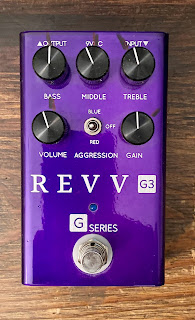
Controls are pretty typical of an amp in a box pedal, Volume, Gain, a three band eq and an "aggression" switch. I'm pretty sure the 3 band eq is active so start with everything at 12 o'clock and cut or boost depending on what your looking for. The Gain is useable through the entire range, it never gets muddy or mushy even on the highest settings. It is very dynamic and touch sensitive so it responds well to your pick attack and cleans up when you roll down the volume. That being said it never really gets "clean", then again that's probably not what your using it for anyway. 

 If you leave the aggression switch off it has a high gain crunch that sounds amazing pushed with higher output humbuckers (it sounds pretty good with PAF style and strat pickups too). In the up position your in "blue" mode. It adds a layer of compression and gain that sounds great for everything from 80's rock and up. The down position is the "red" mode and adds another layer of gain that nails a perfect modern high gain tone. Terms like articulate, clear, and brutal come to mind. It has a very tight bottom end that never gets flubby. My understanding is that the red G4 pedal has a bigger bottom end. 

Revv has been partnering with Two Notes Audio and is building their products right in to some of their latest amps. I use the Two Notes Wall of Sound Plugin with this plugin to add some power amp girth along with the speaker cabs. You can run this pedal in front of a clean amp or into the return of an effects loop. 

I will say that just like some amps take to pedals well and some need to be set a certain way, this pedal is the same. I can get a great crunch sound out of it but then hitting it with a TS or klon type pedal doesn't really work unless I have it set just so. Dynamically it reacts well but I don't love it when it comes to stacking with other pedals. That being said there is a ton of gain on tap and the active eq and the aggression switch make it pretty damn versatile. 

I did not receive compensation in any way for this review and my thoughts and comments are completely my own. 
Thursday, December 30, 2021

Confirmed: New Andy Timmons pedal coming

Chances are if you've found this blog you found it through one of my Andy Timmons post. I'm guessing this because my Andy Timmons Gear Guide is one of the most visited articles on this blog, by far. 

Andy Timmons recently put a picture up on Instagram that had a new pedal on top of his amps. This pedal reminded me of the Keeley ECCOS pedal so I started doing some digging. Sure enough both Robert Keeley and now Andy Timmons have confirmed that they have been working on a signature Andy Timmons Delay pedal. 


What we know so far

So far Keeley has put out the ECCOS and Hydra pedals on what he calls the "dream platform". The ECCOS is a stereo dual delay and the Hydra is a stereo reverb and tremolo. Both have programable settings, are easy to use but also allow for some very deep editing despite having only a few knobs and being in a standard pedal size. 

Keeley Electronics has trademarked the Name HALO DELAY as of a filling in June 2021 

In the past Andy used two EHX Deluxe Memory Man pedals, and then switched to using a Strymon Timeline to replicate this sound and to be more reliable. In the picture it says Halo on the pedal and Andy will be releasing a new album on April 1st 2022 featuring the pedal. Also on a livestream Andy said that the pedal should be released in March. 

Update 3/25/22 : looks like the rollout of the HALO DELAY pedal may be pushed back. I don't have any information other than Robert Keeley said that there was something "mind blowing coming after May and something supernova after that". 

Update 5/24/22: Someone on FB was looking for a Delay/Reverb pedal and Robert Keeley popped in and said that they might want to wait till June 10th! so I am assuming that it is indeed a Delay and Reverb and will be announced at Summer NAMM and available just after. 

What we don't know

Is it a Dual Delay or a Delay and Reverb. I'm guessing it's the second only because Andy's livestreams have had a lot of reverb on them recently. Either way I'm buying a new pedal in March and I'll try and get a review up as soon as possible. 

Update 6/10/22: It's out and the YouTube videos sound incredible. And it is a Dual Delay, yes of course I ordered it as soon as possible. I'll post some pics and videos on Instagram and thoughts here soon after. 


I'll keep this post updated if I get any more information. 

Monday, June 22, 2020

Digitech Freqout Review

There are several different types of artificial sustainers on the market including hand held ones like the ebow and pickups with built in oscillators but pedal sustainers have been mostly let downs for me. the Digitech Freqout has been out for a while and I had seen a few recommendations for it and I was pretty skeptical but I have been quite surprised. 

The Freqout has a very industrial look with a brushed aluminum finish and a screen print on the top that sets it apart from pretty much anything else. 


The first switch can set the foot switch to be a momentary switch meaning it only works when you're stepping on the switch and when you release it turns off. This is great for providing sustain and feedback on demand. Or you can leave it off to act like a normal pedal, keep in mind it is only true bypass if the momentary is left off. The dry switch can kill your initial attack so that all you hear is the effect. This can be used to replicate ebow type sounds. While the pedal looks to have two knobs it actually has 3. The top knob has a Gain and an Onset knob. Onset is how soon the effect kicks in while the Gain knob controls how strong the effect is. These are crucial to how natural the effect will feel. The Type knob sets the feedback that comes in from an octave down to an octave up and you can choose 3rds and 5ths as well as others. There is also a set of LED lights on the left side to help you see when the effect kicks in. 

There is an old trick with cranked tube amps where you stand at a certain spot on the stage and can step back towards your amp for more sustain and closer for more feedback. Most shows I've attended in the last few years have moved to quieter stages and modeling boards and software and you lose that ability. While the freqout isn't exactly that same feel it does help add that feel back in. 

As much as I enjoy a cranked tube amp I find myself using amp sims more and more for practice and recording. The Freqout really does help add a more "live" feel. I love being able to add feedback in a song when recording direct. It also does cool ebow sounds and also ambient drones very well. I've been using it to create pad type sounds with clean chords. 

Keep in mind this pedal reacts with your pickups and needs to be placed absolutely first on your pedalboard. Before wah pedals, compressors and even fuzz pedals so if you have a finicky fuzz pedal it may not work with your setup. This pedal is super fun and great for experimenting with. 

I did not receive compensation in any way for this review and my thoughts and comments are completely my own. 

Tuesday, August 6, 2019

JHS AT Drive Andy Timmons Pedal Review

There is a sound I have searched for, a sound that I first noticed in David Gilmour's Live in Gdansk, Eric Johnson had something similar, Andy Timmons had "that sound" too. Part of it is phrasing but as I dug and dug into their somewhat complicated rigs I found it was partly the sound of the BK Buttler Tube Driver. I say partly because the Tube Driver has to be played into a cranked amp to get that sound and sounds awful at low volumes. With all three of them it is an EL34 based amp. The Hiwatt's for Mr Gilmour and for Eric and Andy old Marshall Plexi's set somewhat clean or crunchy. Andy later switched to Mesa's particularly the Stiletto (which if you read my review was a tweaked clone of his two plexi's). Then a while back JHS and Andy released the AT drive and then shortly after that the AT Drive V2. Then I noticed the Tube Driver wasn't on his board anymore.

I've been using an OCD clone using Bjorn Riss's settings to duplicate the Tube Driver but I finally got my hands on the JHS AT Drive V2 and I will confirm that this pedal can give you "that tone". I've talked about my love of Andy's tone in this post and others and I've played most of his gear at some point or another.

The AT Drive sound reminds me of the lead channel on the Mesa Lonestar, It has a Marshall like quality while being very liquidy and smooth and not to in your face. It's not exactly the Lonestar's lead channel but it has those qualities a kind of chewy power distortion style drive.  I keep seeing people say this sounds like a JCM800... it doesn't. It doesn't sound like any JCM800 I've played through. It doesn't have that punch or in your face roar. If your looking for a Marshall in a box pedal there are other options.

The EQ knob works like a tone knob on your typical three knob drive pedal. All the way to the right is open and then it rolls off the top end as you roll it back. The AIR knob is the really interesting feature in this pedal. It acts similar to the presence knob on an amp opening up the top end of the amp. Finding the right balance between the EQ and the AIR for your setup is the secret here. Once you find that plugging into different amps should only be a matter of adjusting the AIR. The EQ should stay pretty much the same. You might roll it back for brighter amps and forward for more compressed amps. It sounds amazing into both Fendery 6L6 amps and Marshally EL34 amps thanks to the AIR

The toggle switch moves you from 25watts in the up position, 50 watts in the down and 100 watts in the middle. When I owned a Mesa Stiletto it had the option of 100 watt and 50 watt and I don't think the volume difference was this dramatic but it's interesting to note that it adds more compression so if your using this as an overdrive into a gained up amp you may find the 25 watt more useful. You will move your volume knob a lot when deciding where to put this one.

For a long time Andy said he would use a compressor to boost the front end of his amps. The boost section can be used independently making it that much more versatile. If your amp is set clean just below breakup it can push it over the edge to a nice crunch and definitely adds some compression to the sound, rounding off the lows and adding more mids. Adding it in front of the main drive section of the pedal pushes it harder adding more gain and compression but not that much more volume. Still this would be helpful for solos if you need a bit more singing sustain.

As you can imagine if you like stacking gain pedals this pedal is amazing. TS type pedals are good but more open pedals like the Boss Blues Driver (also on Andy's board) and the plethora of Klon klones out there sound glorious with this pedal. Currently I'm stacking the Way Huge Saucy Box with  mine and it's hard not to stay with both of them on. I have to say that as good as it sounds with higher output humbuckers this pedal is amazing with more vintage open sounding pickups. Single coils in particular really sing.

Who might use the JHS AT Drive? Well obviously people who want to sound like Andy, but also minimalist who want less pedals on their board. It's a great overall sound and with the added boost making it very versatile. With just a clean fender-y amp like a Hotrod Deluxe you can have four sounds One clean, second pushed with the boost, third with the main drive sound and forth with the drive and boost together. With a two channel amp like a DSL or similar the options really start to add up.

I got a great deal on this pedal at Replay Guitar Exchange in Tampa and was in no way compensated for this review

Friday, July 12, 2019

The JHS AT Drive + review coming soon

I've wanted one of these since the first version came out. If you've ever read through much of my blog then you know how much of an Andy Timmons fan I am. That tone, that phrasing, the chops, the beautiful melodies... all of it. But the timing has never been right, other things needed to come first. But this week I finally got one and oh my it's glorious. An in depth review is coming in a few weeks and I'll post some clips soon as well.

Monday, November 26, 2018

Way Huge Saucy Box Review

The Way Huge Saucy Box has been out for a while but a few months back one showed up on a Musicians Friend Deal of the Day. I had recently watched a interview with Phil X who was using one on his pedalboard which peaked my interest. And I just couldn't pass up the deal.

If you don't know the story behind Way Huge it was founded by Jeorge Tripps as an early boutique pedal brand in the 90's. Way Huge had it's fans but it didn't become a huge success and Jeorge went to work for Line 6 helping to develop it's famous DL4 and other Stompbox Modelers. Then he went to work for Jim Dunlop and was able to relaunch Way Huge under the Dunlop umbrella of products.

Written off by some to be another Klon klone, the Saucy Box has it's own thing going on. There are some similarities to the Klon, it's got a great boost, it has a gritty low gain drive, and it doesn't add a lot of mid boost or cut low end like a Tube Screamer. But compared to other klones I've played (I've never played a true Klon) it's not the same. It does round of the edge of the high and low frequencies but in a slightly different way that's hard to describe without listening to it.

There is a ton of boost that works great to push your amp which works perfect for solos. The gain is very gritty and can sound harsh on a clean amp but if your driving a crunchy marshally tone it adds a layer of harmonic richness. Fire up a Plexi AC/DC-ish sound and then hit it with Saucy Box and your heaven. It acts as a MORE button except there is no spiky highs or flubby lows. Into this sound it's perfect for soloing or stacking with another drive or fuzz.

 If TS pedals aren't your thing and you want to stand out from the Klone crowd you should definitely checkout the Way Huge Saucy Box.

Saturday, November 18, 2017

RIP Malcolm Young: ADHD Tribute and Thoughts

Malcolm Young of AC/DC has passed. I was never a huge fan of the band but I can't deny their legacy in the hard rock arena. And while a lot of people think of Angus first Malcolm was really the sound of the band. Years ago I met Paul Gilbert at an in store clinic. Someone asked him about getting a great rock sound. He said "Start with AC/DC that Malcolm Young sound, then push it a little more for solos. That's how you get a great rock tone."

My main rock sound is pretty much that. I start with a sound that is more overdriven and then roll off my volume. If it sounds like AC/DC then I know that I'm pretty close to what I want. Then I might push that with a TS pedal or add in wah or delay or something else but that's the best sound out there. 

My two favorite AC/DC songs are Thunderstruck and If You Want Blood. I felt like If You Want Blood was more Malcolm and Thunderstruck is more Angus. So that is my tribute to Malcolm. My old Gibson Sonex plugged into my EVH5150LBX with the gain turned almost all the way down. 


Monday, December 5, 2016

Top Pedal Releases of 2016

2016 has been a rough year for a lot of people but there have been some amazing pedals released. While it isn't quite over most new gear releases will hold off until the 2017 winter NAMM show. So I thought I'd run down my favorite pedals released this year.

Digitech Whammy Ricochet- Whammy's are just fun, I had one for a bit but it never found a permanant place on my board. That said the Ricochet is perfect if you don't need the real time control of a rocker pedal. It can bounce your sound up and down for you via preselected settings.

DOD Carcosa Fuzz- A versatile fuzz that isn't a fuzz face or muff clone the Carcosa fuzz carves out a unique niche but also covers a lot of territory. It's also reasonably priced at $99 and only from PGS.

Keeley Bubbletron- Robert Keeley and crew have been knocking it out of the park lately. The Bubbletron incorporates a load of features including a flanger, phaser, and step filter that can be controlled with an envelope filter to respond to your pick attack. You can choose your sensitivity to the pick attack and roll it off for more traditional sounds. A must have for tone explorers or for people who like a lot of options but don't have extra space on their pedalboards.

Keeley Monterey Fuzz Vibe- This is my pedal of the year. I did a review HERE and can't get over how fantastic this pedal is.  While it may be Mr Keeley's Hendrix in a box it's certainly not limited to it. It's so easy to dial in other sounds as show in THIS post and so incredibly versatile. Don't let the $300 price tag scare you. You could buy 9 pedals and not have this range of sounds.

MXR Echoplex Delay- Man this sounds nice. Combining the Echoplex preamp with a Carbon Copy delay and voicing the repeats a bit darker makes for an incredible sounding easy to use delay pedal. It might be a one trick pony but it does that trick amazingly well.

MXR Phase 95 mini- If you love phasers or mini pedals then this pedal is for you! The Phase 95 has built in sounds from the Phase 90 and 45 as well as a Script and Modern switch. Still it's super easy to use with one knob. The 45 is a much more subtle sound so if you ever tried a Phase 90 and found it to be to much this might do the trick.

TC Electronic Corona SCF- This limited eddition pedal marks the end of the more expensive SCF pedal made famous by players like Eric Johnson and Paul Gilbert and is revered in studios around the world. But due to sourcing problems the SCF will soon be discontinued. Not to fear the Tone wizards at TC have made those sounds availble via toneprint and loaded them all on this pedal. It sounds heavenly.

I'm also looking forward to TC Electronics new bargain line. 13 pedals priced at $50 available at Guitar Center here in the states. Several of these sound really promising and while the cork sniffers won't like them I imagine I'll be adding these to my budget recommendations rather quickly.

What else did I miss? Let me know